
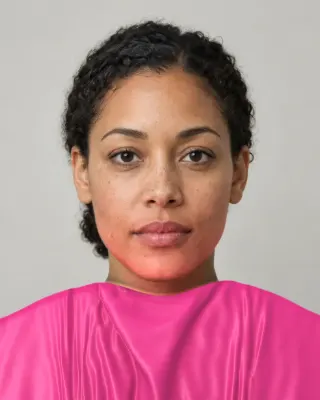

Find your two closest seasons
A color season is a position on three scales: warm or cool, light or deep, soft or bright. Answer those three and you’re usually down to two seasons out of twelve. Nobody can do better than that from a description, which is why this path stops at two.
You don’t need a camera for this. You need a window, something cream, something bright white, and a phone that can turn a picture black and white. Every step has a “can’t tell” on purpose, because plenty of people really can’t on one of them, and that’s useful to know. Choosing it keeps that scale open, and the seasons on both sides stay in play.
1. Warm or cool?
Cream, then bright white, under your chin. Which one leaves your skin looking clearer?
2. Light, middle or deep?
Turn a selfie black and white. Where do your hair, brows and eyes sit overall?
3. Soft or bright?
Do your features blend, or does something stand out sharply, like clear eyes against their whites?
Warm
Light
Middle
Deep
Cool
Light
Middle
Deep
Answer any of the three. Every season above is a link to its palette.
Step one: warm or cool
Start here because it splits the twelve exactly in half. Six seasons lean warm and six lean cool. House of Colour starts its drapes the same way, deciding warm (Spring or Autumn) or cool (Summer or Winter) before anything else. That order is a convention, not a law. If your strongest trait is obviously depth or softness you can start there, and you’ll arrive at the same place.
Stand facing a window with no makeup if you can. Hold something cream under your chin, then something bright white. A paper towel and a cream sweater will do. Look at your skin, and specifically at three places: under your eyes, around your mouth, and along your jaw. The wrong one tends to leave skin looking yellow or grey, or brings shadows forward. The right one lets you stop noticing your skin at all.
Skin that looks pink doesn’t settle this, and neither does a tan. Redness can come from a cold morning, and a tan is a change in depth. If you have deep skin, the same test works, and the place to watch is whether your skin looks rich and even or slightly ashy. Don’t reach for the vein test here, as it’s a poor clue, for reasons the vein test page goes into. If you want a fuller answer on this one scale, the undertone test combines several signals and shows which disagreed.
When you truly can’t tell
Pick “can’t tell” and move on. Nearly neutral coloring is common in the soft seasons, whose temperature is mild: Soft Summer and Soft Autumn sit on either side of neutral and share the same softness. Our comparison page walks through that pair color by color.
Step two: light, middle or deep
Value is how light or dark your coloring is overall, and it’s easier to see with the color taken away. Take a selfie in daylight, turn it black and white in your phone’s editor, and look at your hair, brows and eyes as a group alongside your skin. Mostly pale greys means light. Mostly dark, with black or near-black hair and dark eyes, means deep. Anything else is middle, and most people are.
Deep skin doesn’t make you a Deep season, and pale skin doesn’t make you a Light one. Depth here describes the whole picture. Someone with very pale skin, black hair and dark eyes reads deep or bright. Someone with deep skin can land on any of the twelve, because hair, eyes and how much they stand apart count too. Our scan compresses skin’s contribution on the dark side for this reason, so that depth of skin alone can’t push anyone into Deep Autumn or Deep Winter. Be wary of any chart that shows you only one complexion per season.
Step three: soft or bright
This one is called clarity, and it’s the hardest to judge alone. Soft coloring blends, with hair, eyes and skin close to one another and nothing jumping out. Bright coloring has edges: very clear eyes, whites that stand out, hair that contrasts sharply with skin, or all three. On deep skin, the best place to look is your eyes. The whites of your eyes against your iris make a contrast every face has, whatever its depth, and that’s where our scan looks as well.
To test it, hold a dusty color and a saturated one in the same family under your chin: a dusty teal against a vivid turquoise, or dusty rose against hot pink. Too vivid and you’ll see the fabric before you see yourself. Too muted and your face seems to fade along with it. “In between” is a fine answer, and it’s how you reach the seasons led by temperature: Warm Spring, True Autumn, Cool Summer and Cool Winter.
What the test at the top of this page does
The path asks what you see. The test measures first, then asks. In order:
- Pick your input. Camera, an uploaded photo or our example person. The camera is the better route, because of the next step.
- White paper. On camera, you hold up a plain sheet beside your face. The tool measures how far your camera has drifted from white and shows you a before and after. You can skip it, and your temperature reading then counts for less.
- The color read. It zooms in on your iris, the white of your eye, your cheek, forehead, jaw and hair, and shows the numbers it took from each. These are estimates from this picture in this light.
- Color rounds. Two colors are shown around your photo, never drawn on your face, and you pick the better one or say there’s no difference. There are five to eight rounds, each chosen to separate the seasons still in play.
- Your season. A season out of twelve, shown among the others in a 3D space with your position as an estimate.
- The result. Runner-up, how your choices moved it, six colors, one to avoid, your metals, your readings and a share card.
It feels different from the quiz, which asks about you and can’t see you. Your eyes get the last word here: a few consistent choices can overturn what the camera read. If you’d rather browse colors with no verdict at all, the palettes show every season.
What if two seasons both look fine?
That’s a normal place to end up. Even the field’s own history admits someone can be “on the cusp of two seasons”, while Carole Jackson, who popularized the system, insisted that with testing one palette proves better. Sometimes that’s true. Sometimes you’ll test carefully and still like both. The seasons are boxes drawn across a continuous range, so somebody has to live near each edge. You can wear both palettes and stop worrying.
Still want to settle it? Each season has a nearest rival on our map. Test that one first:
| If you land on | Test it against | Which is |
|---|---|---|
| Light Spring | Warm Spring | deeper |
| Warm Spring | Light Spring | lighter |
| Bright Spring | Bright Winter | cooler |
| Light Summer | Cool Summer | deeper |
| Cool Summer | Soft Summer | softer |
| Soft Summer | Soft Autumn | warmer |
| Soft Autumn | Soft Summer | cooler |
| True Autumn | Soft Autumn | softer |
| Deep Autumn | Deep Winter | cooler |
| Deep Winter | Deep Autumn | warmer |
| Cool Winter | Deep Winter | deeper |
| Bright Winter | Bright Spring | warmer |
Compare just those two palettes, with one color from each held to your face at a time. Pick pairs that differ mainly on the axis in the last column, since that’s the only question left to answer. For how the twelve fit together, see the color analysis chart, and if someone has told you you’re one of sixteen, the 16-season guide explains how those names line up. Once you have a name, your color palette is the next thing to look at, and all twelve are here.
Does dyed hair, a tan or age change your season?
Dyed hair. Bernice Kentner, an early writer on seasons, warned readers not to rely on hair coloring to find theirs. Good advice for a do-it-yourself test: answer the depth question with your natural color in mind. Our scan can only read what’s in front of it, so with dyed hair, your own eyes on the result matter more. Dye is also a choice about what you want to look like, so if you wear a shade every day, it’s fair to test colors against the hair you actually have.
A tan. A tan makes skin deeper and often warmer, and that can shift what a test reads by a season. Test in your untanned state if you want the answer most systems mean, and don’t be surprised if a color you love in August looks odd in February.
Age. House of Colour tells clients their season doesn’t change, and you’ll hear that often. We haven’t found anyone who has measured it. Hair greys, eyes can lighten and skin changes, so it would be odd if the colors that flatter you stayed fixed in every detail. If an old result stops feeling right, run the test again.
A word on what the answer means
Your season isn’t a fact about you in the way your height is. It’s a useful label for a group of colors that tend to work together on someone with your coloring. Carole Jackson herself said she could have called the groups Type A and Type B. It’s a system built on hue, lightness and strength, the same three dimensions Albert Munsell set out, plus a lot of judgment. So take the name lightly and test the colors.