
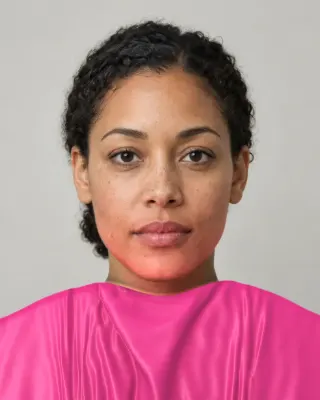
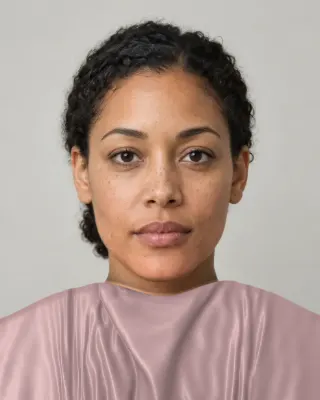
What is my undertone?
Your undertone is the temperature of your skin’s color: whether it leans golden and peachy (warm), pink, red or blue (cool), somewhere between (neutral), or carries a muted green or grey cast (olive). It’s a separate thing from your skin tone, which is how light or dark your skin appears. Someone with very pale skin and someone with very deep skin can share an undertone.
One thing to get out of the way: undertone has no standard clinical definition. Nobody can draw blood and tell you. It’s a term from makeup and styling for something people can often see but struggle to pin down, so every answer, ours included, is an estimate. What this test can do is show its working. If you’d like the idea explained more slowly, what undertone means does that, and how to find your undertone covers doing it without a screen.
Why one test isn’t enough
Search this topic and you’ll get the same four home tests everywhere. Each of them has a flaw you can name:
- Veins. Vein color depends on how skin handles light and on the vessel’s depth and size. The vein test page goes through the optics. Nobody we can find has tested it against undertone.
- Gold or silver. Closer to the point, since you’re looking at metal against skin. But metals mirror the room, and you may simply prefer what you already wear. The gold or silver test explains how that goes wrong.
- White or cream paper. A good comparison in daylight, and misleading under a warm bulb, where both whites shift.
- The sun. Tanning easily is said to mean warm. But tanning says more about melanin and how your skin responds to UV than about temperature.
Even the sellers admit this. Brilliant Earth’s jewelry guide says these tests offer “clues rather than definitive results”. A set of weak clues that point the same way is worth more than one. When they don’t agree, you want to know that too. So this test collects four kinds of evidence and shows you each one separately.
What happens when you run it
- Your picture. Use your camera, upload a photo, or try the example person to see how it works.
- White paper, on camera. You hold a sheet beside your face and the tool measures how far your camera has drifted from white, with a before and after. This is what makes the skin reading worth having. In a photo it estimates the light from the rest of the picture, which is less sure.
- The read. It zooms in on your iris, eye white, cheek, forehead, jaw and hair, and shows the numbers. For this test, only the skin goes into the vote.
- Five color rounds. A warm and a cool color are shown around your photo, never drawn on your face. You choose the one that makes your skin look clearer, or say there’s no difference.
- Two questions. Which jewelry looks best on you, and what color are your wrist veins? “Not sure” is allowed and simply removes that vote.
- The verdict. Warm, cool, neutral or olive, a line on how much the evidence agreed, a marker on a cool-to-warm scale, and a list of what each signal said.
These are the color pairs, always warm against cool:
Pumpkin / Cool Pink Punch
a little apart in lightness, as strong
Salmon / Dusty Rose
as light, apart in strength
Golden Yellow / Lemon Cool
apart in lightness, a little apart in strength
Olive / Cool Jade
a little apart in lightness, a little apart in strength
Warm Coral / Cool Watermelon
a little apart in lightness, a little apart in strength
Look at your skin instead of the fabric: around your mouth, under your eyes, at the overall evenness. The right one doesn’t look exciting. Your skin simply stops asking for attention. If a pair looks identical, say so. “No difference” is honest, and it adds nothing to either side.
What each signal is worth
The votes aren’t equal. These are the weights in the code. They’re our judgment of how much each kind of clue can say, and no study set them.
| Signal | Most it can count | Why |
|---|---|---|
| Your eyes, with the fabrics | 1.2 | It’s the thing you actually care about: how a color looks on your skin. Each decided round adds 0.3, up to this cap. |
| Your skin, measured | 1.0 | Your skin’s hue compared with typical skin at your own lightness. It counts for less when your skin’s color is too faint for the hue to be reliable, which happens more on very deep skin. |
| Your jewelry | 0.45 | A real comparison, tangled up with habit and taste. |
| Your veins | 0.3 | A rough sign, so it can nudge a close call and little more. |
What if your tests disagree?
That’s the usual case, and treating it as a failure is a mistake. Here are real outputs from the tool’s verdict function, on made-up evidence, so you can see what each pattern gets you.
Everything agrees
- Eyes warm
- Camera warm
- Jewelry warm
- Veins warm
The only way to reach the words “everything points the same way”.
Warm
Everything points the same way
Only the veins disagree
- Eyes warm
- Camera warm
- Jewelry warm
- Veins cool
Veins carry the least weight, so the rest wins.
Warm
Most of it points this way
Your eyes against the camera
- Eyes cool
- Camera warm
- Jewelry neutral
- Veins neutral
The two heaviest signals cancel out, and the tool says so.
Neutral
A close call: the evidence doesn't fully agree
Your eyes against your habits
- Eyes cool
- Camera neutral
- Jewelry warm
- Veins warm
Gold and green veins pull against four color rounds, and it comes out even.
Neutral
A close call: the evidence doesn't fully agree
A true muddle
- Eyes neutral
- Camera neutral
- Jewelry warm
- Veins cool
Each signal says something different, so it lands on neutral and calls it close.
Neutral
A close call: the evidence doesn't fully agree
Fabric says cool, camera agrees, jewelry doesn't
- Eyes cool
- Camera cool
- Jewelry warm
Telling you what you already wear isn't strong evidence.
Cool
Most of it points this way
A few things stand out, and they’re useful when you’re reading your own result:
- A clear result needs unanimity. One dissenter, however weak, moves the wording down to “most of it points this way”. We’d rather undersell it.
- Neutral can mean two things. Your skin may really sit in the middle, or strong signals may be cancelling out. Check the list: all votes neutral is a different story from a warm camera and cool eyes.
- When your eyes and the camera fight, suspect the light first. The camera can be fooled by a lamp or a colored wall. Run it again by a window with the paper, then see if the camera moves.
- When your eyes and your jewelry fight, suspect habit. Most people have worn one metal for years. Try the other with fresh eyes in the gold or silver test.
To break a tie by hand, take one color in a warm and a cool version, like a coral and a watermelon, and hold them to your face in daylight with someone watching. Do this on two different days. If the verdict keeps moving, you’re probably close to neutral, which is a perfectly good thing to be. Many colors will work for you.
Which test is the most reliable?
We can’t give you a ranking backed by data, because we couldn’t find one. No study we’ve seen compares these tests against each other, partly because there’s no agreed answer to compare them with. Here’s our judgment, which you’re free to reject: real fabric in daylight first, then a calibrated camera read, then metals, then veins. That order follows one principle. The closer a test is to the thing you actually want, which is a color looking good on your face, the more we trust it.
Where olive fits
Olive is where the experts really do disagree. A color analyst quoted by IPSY treats olive as a surface overtone, not an undertone at all, and a makeup artist in the same article estimates that about 90% of olive-skinned people have a cool undertone. A Spanish guide describes it as a green cast added on top of cool, neutral or warm, and places most of them near neutral. Those are opinions from people who work with skin, and neither comes with data.
So what does our result mean? The tool says “olive” when your skin reads low in red for its lightness, with a hue on the yellow-green side of what’s typical at that depth, and the overall vote isn’t cool. If the vote leans cool, it says cool, even with an olive cast. The word describes the muted, greenish look that many golden and pink shades sit oddly on. It doesn’t claim to settle the debate. Our olive skin guide has more, including what to wear.
Does this work on deep skin?
It was built to, and you should know how far that has been tested. Skin hue is judged against what’s typical at your own depth, since fixed cut-offs tend to fail on deep skin. Where your skin has too little measured color to trust, the tool says less and your eyes count for more. But nothing has been tested on real people yet, and the fictional portraits we used don’t cover the deepest tones, so that end of the range has the weakest evidence. Lean on the color rounds. Warm and cool still look different on deep skin: warm tends to look rich and golden, and the wrong one ashy or flat.
Can your undertone change?
You’ll often read that it can’t. Skincare.com describes skin tone as what can fluctuate, for instance with a tan, and undertone as the underlying tint. That’s a common claim, though we haven’t found it measured. Sun, redness and a change of foundation all change what any test reads on the day. A result that shifts between summer and winter doesn’t mean you did it wrong. Test when your skin is at its usual, without a recent tan.
What to do with your result
Use it for the decisions that depend on temperature, like which foundation family to try and which metal to buy. For clothes, undertone alone won’t get you far, because it can’t tell a pale person’s best blue from a deep person’s. That takes depth and clarity as well. The result’s button leads to the full scan, and the season test explains how the three scales narrow twelve seasons to two. Our guide to skin tones covers the depth side.