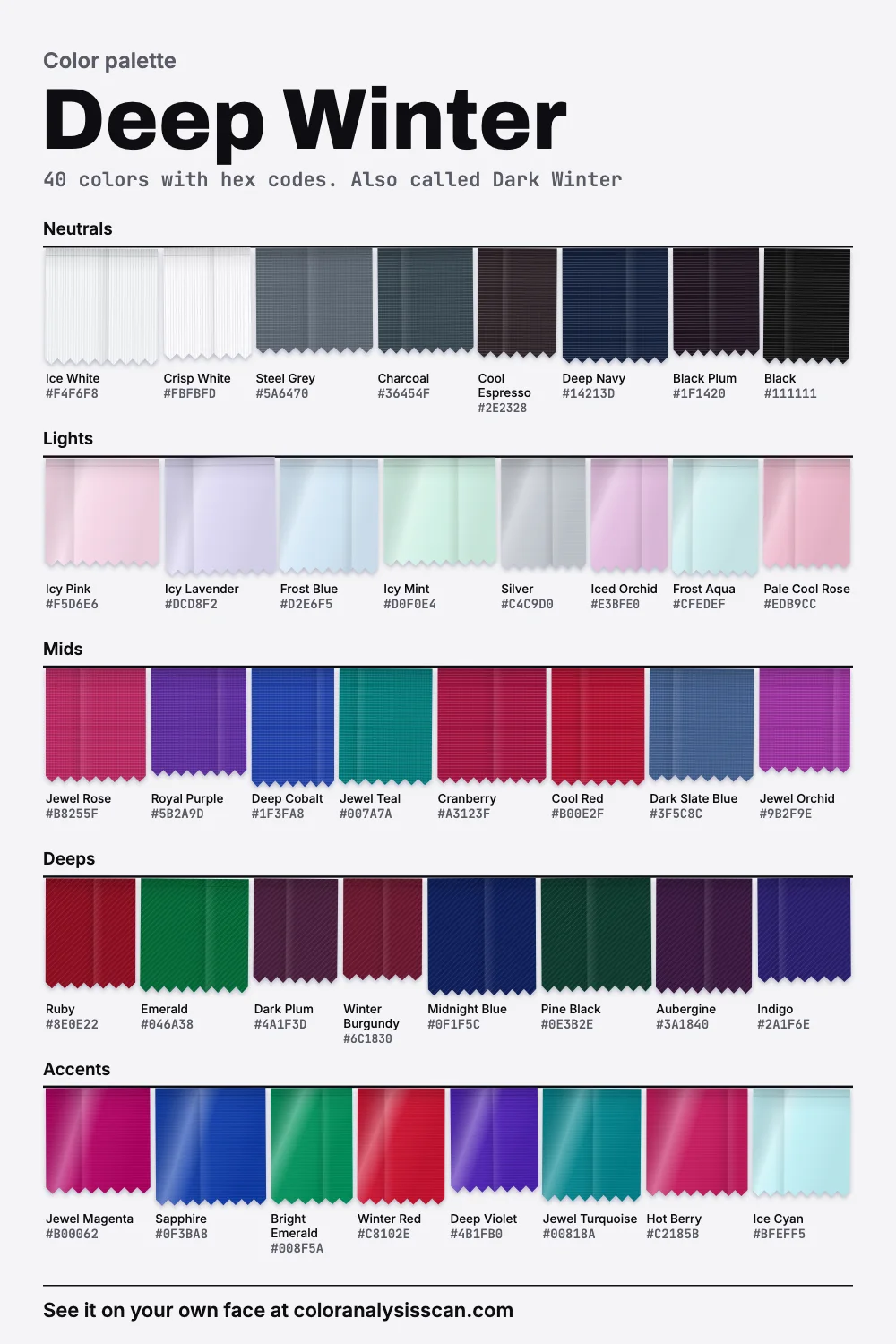
Deep Winter color palette (Dark Winter): dark, cool colors
The Deep Winter color palette is dark first, cool second. Black works here, along with ruby, emerald and ice, and the real skill is keeping all that darkness rich and never harsh.
The Deep Winter palette
40 colors with hex codes. Also called Dark Winter. Tap any color to copy its hex code.
Neutrals
Lights
Mids
Deeps
Accents
Dark isn’t the same as harsh
This is the question the season keeps raising. You’re told black is your color, you put on a black polo neck, and on some days you look striking and on others you look like you haven’t slept. The word “dark” only describes the garment. “Harsh” describes what happens between the garment and your face: a sharp step with nothing to soften it, or a large area of darkness with no light note to balance it. Both are fixable, and neither means you’ve got the wrong season.
Deep Winter is described as deep first and cool second, with dark hair and eyes carrying the depth. That’s why dark clothing can behave so differently here than on other seasons: on a Deep Winter it extends something already in the face. The palette’s numbers back that up, since 40% of our colors are dark, the highest share of the twelve, and the board runs from a crisp white all the way down to black.
A palette with a hole in the middle
Look at the picture at the top of this page. Nearly all forty colors sit at one end or the other: dark jewels and near-blacks, or ice. Only three sit in the middle range of lightness, and between Bright Emerald and Pale Cool Rose there’s an empty stretch, the widest such gap in any of our twelve palettes. The palette was written by hand from the season’s traditional definition, and the shape only shows up once you plot it.
It also predicts the avoid list. Of the five colors we steer you away from, four land inside that hole: Dusty Olive, Camel, Orange and Mustard. Those are medium, warm, slightly earthy colors, and they’re precisely what this palette has no room for.
A note on two other figures that could mislead you. 45% of the board counts as muted by our cutoff, which sounds soft and isn’t: that group is mostly black, white, navy and the pale icy tints, all low in color for a different reason than a dusty rose. And the average warmth looks barely cool, because our warmth measure scores every red as warm, even a blue-based Ruby. On the share measure, 37.5% of the colors read cool against 20% warm. Everything here describes our palette, so none of it tells you anything directly about a person.
Deep Winter or Dark Winter?
Two names, and in most 12-season systems one season, so a Dark Winter color palette and this one are trying to describe the same thing. Sixteen-season systems can swap the labels around: Agile Styling’s 16-season method calls its version Deep Winter while its 12-season chart says Dark Winter, and warns that palettes in comparable positions aren’t necessarily the same. If you were typed in another system, check its fan against this board before you go shopping.
Is this your season?
The neighbor everyone confuses this with is Deep Autumn, and with good reason. Our two palettes are level in lightness and close in strength. Temperature is the only thing pulling them apart, and it pulls hard: Deep Autumn runs very warm, Deep Winter close to neutral. Hold Black and a dark brown under your chin. If the brown makes you look tired and the black makes you look awake, you lean Winter. The full comparison gives you more pairs to try.
Inside the winter family, Cool Winter has more middle ground and is lighter on average, and Bright Winter is far more vivid. If vivid colors outshine you but dark jewel tones don’t, you’re probably here.
One thing this season must not be mistaken for is a synonym for dark skin. Color Me Beautiful, the 1980 book that spread the seasons, has been criticized for focusing on white readers and putting all people of color into Winter. That’s poor analysis. Deep skin can belong to any season, and a person with fair skin and black hair can be a Deep Winter. Soul of Color’s description gives skin from medium to dark with black or brown-black hair and deep eyes, while saying the main quality is depth relative to the person. See where your own face lands with the season test, which shows your colors beside your photo.
Does black work?
Yes, and it’s on our board. Soul of Color goes further and calls black “made for” this season. Black was also on Carole Jackson’s original Winter list, alongside white, true red, fuchsia and cobalt. Our near-blacks give you options: Black Plum and Cool Espresso read as black from a distance with a slight undertone up close, and Deep Navy is the one to use when black starts to feel like a uniform.
One old observation is useful when mixing them. In the 1820s Michel Eugène Chevreul, the director of dyeing at the Gobelins tapestry works in Paris, investigated complaints about a weak black dye. The dye was fine. The black only looked weak and reddish when surrounded by deep blues and purples. He named the effect simultaneous contrast. So if a black jacket looks oddly brown next to your Sapphire top, your eyes are at work and the jacket may well be fine. Move a white or ice note between the two and the black will recover.
Using contrast on purpose
Since your palette is mostly two extremes, you have to choose how you combine them. A dark and an ice give you a sharp graphic edge. Two darks give you depth with no edge. Contrast ratio, the measure web designers use to check text against its background, puts numbers on this. It isn’t a rule for clothes. It’s a useful scale for a thing people usually only feel.
Black + Crisp White
Aubergine + Frost Aqua
Deep Navy + Icy Pink
Ruby + Silver
Emerald + Pale Cool Rose
Royal Purple + Jewel Teal
Ruby + Dark Plum
Cool Espresso + Black Plum
When an outfit feels harsh, you’re usually at the top of that list with all the dark on one side, such as a black dress under a pale face with no other note. Bring it down a step, with Winter Burgundy or Deep Navy, or add a little mid-strength color at the collar, such as Jewel Rose. When an outfit feels heavy, you’re at the bottom. Add a light. On deep skin, the same logic often runs in reverse: a black neckline may sit close to your own depth, and Frost Blue or Crisp White is what brings the contrast to the face.
Deep Winter outfits
Dark with one bright
Black
Crisp White
Charcoal
Ruby
One jewel, head to knee
Emerald
Deep Navy
Black
Silver
Ice at the collar
Icy Lavender
Black Plum
Winter Burgundy
Cool Espresso
Texture matters more than usual, because so many of these colors are dark. Black in matte wool, in satin and in leather are three different things, and wearing them together gets you depth without adding any color. Jewel tones look strongest in fabrics with some light in them, such as silk, velvet and fine knit. Avoid washed or faded finishes: a garment-dyed Emerald drifts toward the muddy middle this palette keeps out. Prints work when they’re crisp, with hard edges and clear jewel or black-and-ice contrasts.
Deep Winter makeup
The brief version: deep berry, cool red and wine on the lips, cool plum or deep rose on the cheeks, and black, charcoal and deep plum on the eyes. The full Deep Winter makeup page has each shade with its code, and shows where a red stops being cool.
Do pale colors belong at all?
Sources split on this, and it’s worth being exact. Soul of Color says that anything too light, naming pale yellow, cream and light coral, washes this season out. Yet 27.5% of our board is light, so what gives? Look at which pale colors those are. Theirs are warm and ours are cold. Icy Pink, Icy Lavender, Frost Blue and Icy Mint carry very little color, and they act almost like tinted whites. Used in small amounts at the collar, they supply the light that keeps all this darkness from closing in. A full dress in Icy Mint is another matter. Most Deep Winters will prefer ice as an accent, with something dark doing the heavy work.
The colors to skip, and the odd one out
Beyond the four that fall in the hole, the last avoid color is Peach. It’s pale enough to sit near your ice colors, but it’s warm and sweet where those are cold. Try Pale Cool Rose as a swap. Same job, opposite temperature. Keep in mind that colors on this list matter most at the neckline. Camel shoes won’t ruin anything.
Metals and shopping
Polished silver, platinum and white gold are our picks, in a piece with some weight, since delicate jewelry can vanish against this much depth. Shopping, the classic trap is low light: in a store, navy, black, charcoal and dark brown can all look alike, so step toward a window before you decide. Compare any near-black against something you know is black. If it shows brown or green beside it, this palette will show that too.
To begin, buy a true black piece in a fabric you love, then crisp white, then one jewel color from the signature set, such as emerald or ruby, then charcoal and an ice like icy pink. Five pieces will combine in almost every way. The deepest color on our board is Black, and you can copy every hex above. Other names and typings are on the Deep Winter celebrities page, sister palettes on the winter palette page, and every season on the palettes hub. The Full Color Report covers a personal cut of this palette.
Related guides and tools
Sources
Full Color Report
Orange is on the Deep Winter avoid list. Here's why.
The answer is in the report.
$19one time. No subscription.
An in-person color analysis costs about $200 to $600. See a cost guide
Full Color Report
Deep Winter


Personal palette
Metals
Silver, platinum and white gold
Makeup
Deep berry, cool red and wine.
What's included
- Fifteen AI pictures of you: 3 best colors beside 3 worst, your lead color, 3 hair colors, day and evening makeup, 2 outfits, and glasses with jewelry
- What we measured on your face: undertone, depth, clarity and contrast, and how close your second season was
- Your full palette of about 40 named colors, with hex codes and how to use each group
- Your colors to avoid, why, and how to wear them away from your face
- Makeup from foundation to nails: lips, blush, eyeshadow, liner and brows, with a day and an evening look
- Hair colors to choose and to skip, and what to say to your colorist
- Metals, jewelry, glasses frames and leathers in your colors
- Your contrast level, your white and your black, suit and coat colors, prints, fabrics and denim
- A capsule wardrobe as outfit formulas, every piece in your colors
- A shopping guide: the color names to search for and the label words to skip
- The "Does this suit me?" checker for anything you might buy
- Your second season, and when to borrow from it
- A PDF of the whole report, a swatch card, a phone wallpaper and a share card, saved to your account
Common questions
- What is a Deep Winter?
- A coloring described as deep first and cool second, usually with dark hair and eyes and a cool or neutral cast. The palette leans on black, white and jewel tones. It describes how coloring relates, not a skin depth: Deep Winters can be fair, medium or dark.
- Is Dark Winter the same as Deep Winter?
- In most 12-season systems, yes, they are two names for one season. Some 16-season systems use Deep Winter as their own palette, and Agile Styling says it isn't automatically identical to a 12-season Dark Winter, so check which chart you were typed with.
- What colors should a Deep Winter avoid?
- Mostly medium, warm, earthy colors: orange, camel, mustard and dusty olive. They fall in a stretch of medium lightness where our palette has nothing at all. Peach is the fifth, pale but warm.
- How do I wear black as a Deep Winter without looking harsh?
- Break the large dark area with one light or bright note near the face, such as a crisp white collar or a jewel-toned scarf. If it still feels severe, swap black for deep navy or black plum at the neckline.
- What makeup suits a Deep Winter?
- Deep berry, cool red and wine lips, cool plum or deep rose blush, and black, charcoal or deep plum on the eyes. Black liner usually works. Warm bronzers and orange-leaning blushes tend to fight this palette.
- How can I tell Deep Winter from Deep Autumn?
- Not by how dark you are, since on average our two palettes are almost equally deep. The split is temperature. Compare true black with a dark warm brown under your chin in daylight: awake in black means Winter, awake in brown means Autumn.

See which colors are yours.
See your colors on your own face, compare seasons side by side, and get your season, your undertone and a starter palette.