What is my color palette? How to find yours in 4 steps
Your color palette is the group of colors that look best next to your natural coloring. You can find it yourself in four steps, without buying anything: three questions about your coloring, then a test of the two seasons they point to.
Do you need a season to have a palette?
No. A season is a shortcut: a name for a set of colors that someone has already grouped. What you really want is a shorter list of colors you can trust. That list can come from a season, from an analyst or from a morning with your closet in front of a window. We use seasons below because they’re a handy way to reach a ready-made list, and you can drop the name once you have the colors.
You’ll need a window, a mirror and about half a dozen plain things from your closet in clearly different colors. Scarves and T-shirts are ideal. Take off any makeup first, or at least foundation and lipstick. Avoid direct sun, and turn off warm bulbs.
Step 1: find your temperature
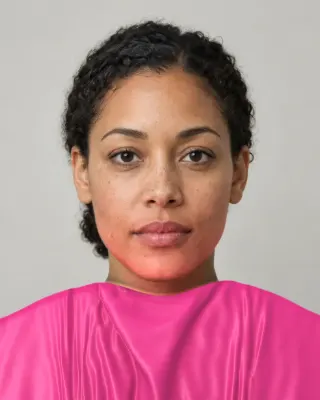
Hold a warm color and then a cool one under your chin, keeping both about equally strong. Teal against rust works, and so does cream against icy pink. Don’t judge the fabric. Watch the skin around your mouth and under your eyes. Does it look more even with one, or do shadows and redness show up?
If you want a test with a camera, the undertone test runs warm and cool pairs and also reads your skin against white paper. The tests people usually start with, veins and gold against silver, tell you less, and our ranked list of undertone tests explains why. Skincare.com says your undertone doesn’t change even when your surface tone does, which is the usual claim, though nobody has really tested it.
Step 2: find your depth
Take a photo of your face and turn it to black and white. Without the color to distract you, are your hair, eyes and skin all fairly light, all fairly deep, or spread widely apart? Dark hair and eyes with fair skin is high contrast. Hair and eyes close to your skin’s depth is low contrast, and on a deep complexion it can look rich and even. Depth is about your overall coloring, not your skin alone, so a deep complexion isn’t automatically a “deep” season. The contrast guide goes further.
Step 3: find your clarity
This is the step most people skip, and it’s often the one that solves the puzzle. Take a dusty, greyed color and a vivid one of about the same lightness, say a sage and an emerald. With the vivid one, do you see the color first and your face second? Then you may lean soft. Does the dusty one make you look flat and tired, while the vivid one wakes you up? Then you may lean clear. The scan makes this quick: it reads your face and shows color pairs beside your photo for you to choose between. Confirm your favorites with real cloth.
Step 4: test your two nearest seasons
Now combine your answers. Pick what you found below. The result is the two seasons whose starting points sit nearest, using the same three axes our scan uses. It only adds up your answers. It doesn’t measure anything about you.
Warm or cool colors flatter you more
Your overall coloring
What looks better near your face
Nearest two seasons on these answers
Go to both palettes, hold a few of each season’s colors up to your face, and keep the ones that clearly win. You don’t need exact matches to start: look for the nearest thing in your closet. The season test does this properly if you’d rather have a verdict, and the quiz is the camera-free route. If you land between two, that’s normal, and you can borrow from both. Your palette doesn’t have to be a single season.
How many colors should a palette have?
There’s no right number, and the industry can’t agree on one either. Here’s what’s on offer from pages we read on November 4, 2026:
| Where | Colors |
|---|---|
| A House of Colour fan | 36 |
| Each season on this site | 40 |
| A True Colour International swatch book | 65+ |
| A 12-tone swatch book in Kentucky | 78 |
| The Dressika app’s clothing colors | 120 |
More colors don’t make a palette more accurate. They give you more to match against in a shop, which helps if you’re matching exactly and hurts if you’re deciding what to buy. For day-to-day dressing, the working number is much smaller: two or three neutrals you can build on, plus four to six colors you actually like wearing near your face. If a color from your palette does nothing for you, leave it out.
Your starting colors, ready to copy
Here are six colors from each of our twelve seasons, as hex codes you can tap to copy. Use them in a shopping app’s color filter, on a phone wallpaper or as a reference when you’re comparing fabric. Each season’s page has all forty.
What if nothing looks right?
- Everything looks about the same. Try stronger comparisons first, or try again in brighter indirect light. If the extremes still look alike, you may have a very flexible coloring, or you’re in a poor light.
- You get different answers on different days. That’s usually light or skin state, such as a flush or a tan. Repeat at the same time of day, by the same window.
- You’ve dyed your hair. Judge with your natural root color in mind, or pull your hair back. Your current hair still matters for what you wear this year.
- You love a color that fails the test. Wear it away from your face, or with a better color at the collar.
One vendor’s draping notes admit that screens can’t fully replace this, and we agree. Real fabric, in daylight, is the final test of any list, ours included. If you want a person to do it with you, see how to find an analyst.
Related guides and tools
Sources

The Full Color Report: $19one time
You in your best and worst colors, about 40 colors with hex codes, makeup, hair and a capsule wardrobe plan.
See a sample reportCommon questions
- How do I find my color palette for free?
- Compare warm and cool, then light and deep, then soft and clear colors against your face in daylight. Combine the answers to reach your two closest seasons, and test their colors. You can do it with clothes you own, or with a free camera tool such as our scan.
- What is my color palette if I have dark skin?
- The same steps apply, because depth is only one of the three answers. Deep skin occurs in every season. Skip vein tests and use richer color pairs, and don't let anyone assign you Winter or Deep Autumn on skin alone.
- Can my palette come from more than one season?
- Yes. Seasons are a convention, and plenty of people sit between two. If colors from both pass your test, keep both. The goal is colors that work on you rather than a tidy label.
- What's the difference between a color palette and a color season?
- A season is a named category. A palette is the set of colors you actually use. A season comes with a suggested palette, but two systems may give the same season different colors, and your own working palette will be smaller.
- How do I use my palette when shopping?
- Start with neutrals, since you'll wear them the most, then add colors near your face. Hold the item up in daylight if you can. Pale, dark and dusty colors are the easiest to misjudge in a store, so step toward a window.

See which colors are yours.
See your colors on your own face, compare seasons side by side, and get your season, your undertone and a starter palette.