
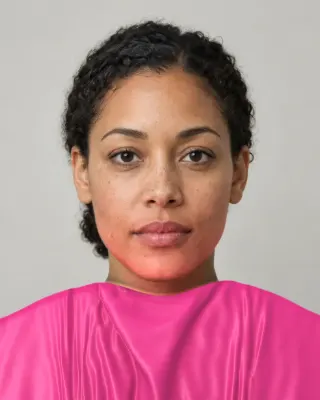
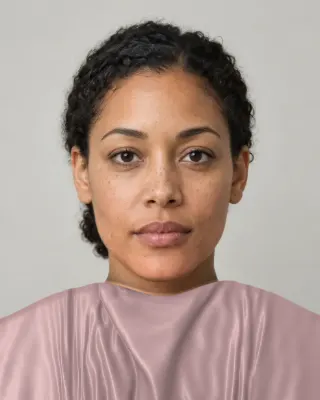
What this foundation shade finder gives you
You get a depth family, an undertone code and the neighbors worth trying. On camera, the finder finds your face, asks you to hold up white paper so it can correct for your room’s light, and reads your cheek, forehead and jaw across several frames. Two quick questions follow, about which jewelry looks best on you and what color your wrist veins are. From a photo it skips the paper and estimates the light.
The result reads something like “Medium, neutral undertone” with a code of C, N, W or O for cool, neutral, warm or olive. It also lists the depths on either side, because no reading can place you exactly. It’s a reading from one picture in one light, and every number behind it is an estimate.
What you won’t get is a line like “your match is 220 Natural Beige”. Plenty of brand finders do that, within their own ranges, and we have no shade data to do it with. A camera also can’t see how a formula sits on skin. If you already wear a shade you like and want it translated across brands, Findation is built for that: you enter shades you’ve worn, and it matches across its list, which it puts at over 11,000 products and 107,000 shades.
Where our seven depths sit
The seven names are our own cut of the lightness scale, from the deepest skin to the fairest. Brand ranges use their own words and their own steps, so treat these as a rough position and no more. To give them a fixed reference, here they are beside the published Monk Skin Tone Scale, and beside what brands were actually selling in the one dataset we could find.
Two things stand out. One is that the Monk scale jumps straight past our Light to Medium band, because its swatches are spaced unevenly across lightness, so that family has no reference tone at all. The other is how unevenly shades were spread. Across six US bestsellers, 108 of 167 shades sat in the top three families and 4 in Rich. Fenty’s 40 had 1 in Rich, and Make Up For Ever’s 40 had 0. Japan’s bestsellers had nothing below Medium, while Nigeria’s had 30 of 50 in Medium and Tan.
The Pudding’s essay found this pattern first, and its data is public. It’s eight years old, so it can’t tell you what any counter stocks today. It does explain an experience you may have had. If you land in Deep or Rich, a range may simply offer fewer choices: 21 of 167 in that 2018 sample. A shade that’s close but not right may be the range’s limit and not your mistake, so try another range before you decide your skin is hard to match.
How to find your foundation shade: the jaw test
Your family narrows the search. Choosing a shade still takes a test on your skin, and it’s a simple one. Most of this follows L’Oréal Paris’s guide, which is sound even though it’s selling you something.
- Pick three. The shade closest to your family, one lighter and one deeper, all at the same undertone.
- Swatch across the jawline. Short stripes, side by side, from your lower cheek down onto your neck. Skip your hand and forearm, whose color is rarely the same as your face.
- Wait. Some formulas settle and deepen a little after a few minutes, so a shade that looks perfect right away can end up a touch dark.
- Take a mirror to a window. Store lighting and fluorescent tubes change how pigment looks. Check in daylight, and indoors as well if that’s where you’ll be seen.
- Keep the stripe that disappears. You should see where the stripe stops only because you know where you painted it.
Face, jaw or chest?
The jaw, because it joins your face to your neck, and what people notice is the line between them. If your face and body differ, because of sun or redness or a spray tan, L’Oréal suggests testing on the center of your upper chest to bring the two together. Our practical addition: if your cheeks read redder than your jaw, don’t match to the cheek, since that matches the flush and leaves a pink mask on your neck.
How to read the stripes
- All three look too pink: you’re on the wrong undertone. Go a step more neutral or more yellow.
- All three look too yellow or orange: the same in the other direction. Olive skin may find both pink and yellow wrong, which points to a neutral or an olive family.
- The lean is right but it’s too light or too deep: stay on the same letter and move along the numbers.
- It vanishes on your face and shows on your neck: go by your neck.
Why the same letter means different things
This is where most shade finders leave you stranded. “Warm” and “cool” on a bottle aren’t standardized. Here’s what the keys we could read actually say:
| System | Cool means | Warm means | Olive |
|---|---|---|---|
| L’Oréal Paris | Hints of blue or pink | More golden or yellow | Not named. Bottles use C, N or W. |
| Estée Lauder | Rosy tone, burns easily | Golden or olive tone, tans easily | Filed under warm |
| Maybelline Fit Me | Offered as a filter, not defined on this page | Offered as a filter, not defined on this page | Not named |
| M·A·C | C is defined as golden | W is defined as rosy | Not named |
| This finder | C: pink, red or blue lean | W: golden or peachy lean | O: its own code |
Read that M·A·C row twice. It runs opposite to the others. So a person with golden, warm skin who asks a M·A·C counter for a W shade goes the wrong way. We go through this properly on warm undertones and cool undertones, with M·A·C’s own words. For this page, the rule is simple: when you see a letter, ask what it means at that brand, and when in doubt describe your skin in plain words, rosy or golden, not warm or cool. What undertone means covers the background.
Numbers are no more portable than letters. A 220 in one line says nothing about a 220 in another, and two lines from the same brand can differ. That’s why you should expect a re-test every time you change products, even from the same counter.
What foundation shade am I if I’m olive?
The finder returns the O code when your skin reads olive, which it only does in the middle of the depth range, roughly Monk tones 6 and 7. Outside that band, olive skin will read as warm or neutral, so a Fair or Rich result with W or N can still hide an olive cast. If pink shades look like a mask and yellow ones look too bright, that’s the classic sign. IPSY’s artists describe exactly this. Try a neutral at your depth first, then look for a range with an olive family. The olive undertone page has more.
Do I need a different shade in summer?
If your skin changes, yes. L’Oréal suggests keeping one for cooler months and one a step or two deeper for summer. Because depth and lean are separate, a tan usually moves you along the numbers, and your letter stays about where it was. Run the finder again if your skin has changed, and use the same window, because the light matters as much as the tan does.
How far to trust the reading
Treat it as a place to start. The white paper step corrects for the color of your room’s light, but it can’t remove shadows, a phone’s own processing, or makeup you’re already wearing. Deep skin is where our evidence is thinnest, since nothing here has yet been tested on real people across the range. Measured lightness itself isn’t perfectly even to the eye. So use the neighbors the result suggests, and if a stripe disagrees with the reading, believe the stripe.
For a closer look at depth alone, use the skin tone test and the skin tone chart, and skin tones explained has the wider picture. When your base is settled, the lipstick shade finder lets you try shades on your own lips. The Full Color Report adds makeup shades chosen for your full palette.
Related guides and tools
Sources
- How to find your foundation color match
- Foundation finder
- Fit Me Matte + Poreless Foundation Makeup
- Beauty Brawl: the diversity of makeup shades, with its data. Li J, Thomas A
- shades.csv, foundation shades sampled from brand sites in May 2018
- Findation: foundation color matching
- How to tell if you have olive skin, according to expert makeup artists
- Foundation shade finder
- Monk Skin Tone Scale