
Skin tone or undertone: two different questions
Skin tone is how light or dark your skin appears, and it can move through the year if you tan. Undertone is the tint underneath, warm or cool. People often mix them up, and a lot of “what is my skin tone” advice is really about undertone. This test is about depth only. It doesn’t tell you your undertone, and it doesn’t judge anything: no tone is better than another, and it’s a description, like a shoe size. For temperature, run the undertone test.
What you get, and what it runs on
The test uses your camera, or a photo if you prefer, and takes these steps. With a camera, it finds your face and guides you if you’re too close, too far or in poor light. It asks for a sheet of white paper and shows you a before and after. Then it samples your skin in several places across several frames, trimming highlights and shadows, so that one flicker or a shiny patch can’t decide. With a photo, or with our example person, it skips the paper and starts at the read.
The result is short:
- Your skin tone in plain words, from very light to dark, using the six groups skin researchers use.
- Your place on the Monk Skin Tone Scale, marked on its ten published tones.
- The word “estimate”, because that’s what this is: one picture, in one light.
Other groupings exist: one published grouping puts tones 1 to 4 in light, 5 and 6 in medium, and 7 to 10 in dark. To see whether the reading holds, run it twice: once by a window and once in another room. A move of one tone is normal, and more than that points to the light.
Why your phone keeps changing the answer
A camera doesn’t record color the way your eye believes it sees it. Your visual system quietly corrects for the light, which is why a white page looks white at noon and at sunset. A phone has to guess at that correction with every shot, which is what white balance means, and it decides on an exposure at the same time. A warm lamp, a green wall or a dark background can each push those decisions and move your skin in the picture.
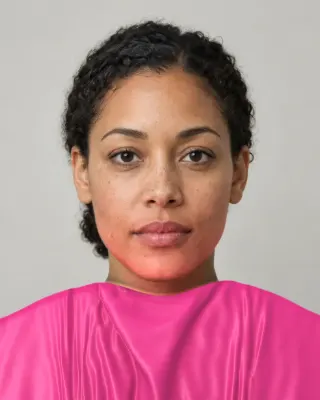
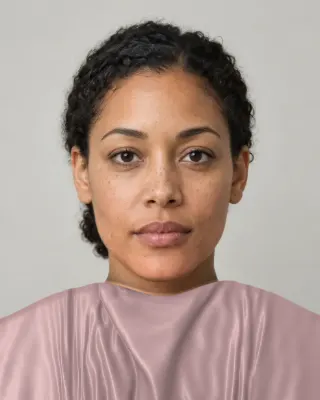
Paper fixes the part that can be fixed. It’s the one thing in the room known to be white, so the tool measures how far off it reads and corrects every color by the same amount. It also nudges brightness, partway, based on how much light the sheet is getting. Here’s what that does to one made-up skin color in a warm, dim room:
Matched against the Monk Skin Tone Scale (Ellis Monk, CC BY 4.0).
What paper can’t fix:
- Uneven light. If the paper is in the sun and your face isn’t, the correction belongs to the paper. Keep them in the same light.
- Hard shadow and glare. The sampling trims them, but half a face in shadow is still half a face in shadow. Face the window.
- A filter, beauty mode or heavy foundation. It will faithfully read what’s in the picture. Use bare skin if you want your skin measured.
- A camera that won’t hold still. Where a browser allows it, the tool locks white balance after the paper. Where it can’t, it says so and corrects each reading from the frames taken while you held the sheet.
Which skin tone scale should you use?
You’ll run into several, and they answer different questions:
| Scale | Measures | Good for |
|---|---|---|
| Monk Skin Tone Scale | Ten tones of skin as it appears, by Ellis Monk with Google | Describing depth. It was developed for fairer evaluation of computer vision. Licensed CC BY 4.0. |
| Fitzpatrick phototype | Six types, based on how skin burns and tans | Sun response. It isn’t a color scale, and an IEEE study found it “poorly predictive of skin tone”. |
| Individual typology angle | One number from how light and how yellow skin measures, grouped into six bands | Research on skin. It comes from Chardon and colleagues in 1991, and Del Bino and colleagues used it to group skin from light to dark. |
| Makeup names | Fair, medium, deep, or a brand’s own words | Shopping. There’s no shared standard, so a brand’s “medium” is its own. |
We match against Monk because it has an open license, enough steps to be useful and few enough that people can use it consistently. Ellis Monk’s reasoning is that past about 10 or 12 points, people can’t reliably pick the same tone twice. The plain-words group comes from the same reading.
The ten tones, and how the match works
| Tone | Swatch | Hex | Skin tone |
|---|---|---|---|
| 1 | #F6EDE4 | very light | |
| 2 | #F3E7DB | very light | |
| 3 | #F7EAD0 | very light | |
| 4 | #EADABA | very light | |
| 5 | #D7BD96 | light | |
| 6 | #A07E56 | tan | |
| 7 | #825C43 | brown | |
| 8 | #604134 | dark | |
| 9 | #3A312A | dark | |
| 10 | #292420 | dark |
Matched against the Monk Skin Tone Scale (Ellis Monk, CC BY 4.0).
The test finds the nearest swatch to your reading. Lightness counts about four times as much as hue, because depth is what the scale is for and the swatches lean yellower than skin looks to a camera. Pick up the numbers and two limits become obvious, and you should know them before you trust your result:
- The light end rests on our judgment. Tones 1 to 3 are paler than a camera tends to report even fair skin. So for light readings the test first moves your reading up to the lightness of the swatch it looks like. Those points are ours, and nobody has tested them on real people. Our fictional sample has a fair cheek and lands on tone 5. If you’re very fair and the tone looks wrong to you, trust your eye.
- The steps aren’t even. The jump in lightness from tone 5 to tone 6 is several times the step from tone 1 to tone 2. In the middle of the scale, a real change in your skin may not move the tone. Read the result as a neighborhood, not a point.
Color measurement itself isn’t perfectly even to the eye either, so don’t read much into small differences. The deepest tones have the least support of all: as skin gets deeper, its measured color gets fainter and camera noise matters more, and we haven’t yet tested this on real people at any depth. Treat every result as a place to start.
Does it work on deep skin?
It was designed not to penalize you, and it hasn’t yet earned more than that. Plenty of tools treat a deep face as a badly lit picture. Our light check looks at the brightest part of your face, not its average, because an average follows skin tone and would tell someone with deep skin to find more light for no reason. The Monk scale itself gives more room to deep skin than older scales: it was developed partly because Fitzpatrick tends to under-represent darker shades, and four of its ten tones sit in that range.
The limit is evidence. Our test portraits are fictional, and none goes deeper than about tone 6 without being artificially darkened. Very deep skin also carries less measurable color, so small errors count for more. If your reading looks wrong against the swatches, believe your eyes. The number isn’t worth arguing with.
How to find your skin tone without makeup or a camera
- Take off foundation and tinted sunscreen, and wait until any flush from washing has gone.
- Stand by a window. Use your jaw and neck, since your cheeks and nose are more likely to be pink or sun-marked.
- Compare to something printed if you can. Screens have their own brightness and color, so a swatch on your phone is only a rough guide.
- Check the inside of your upper arm as well. It sees less sun, so the gap between it and your face shows how much of your tone is a tan.
Skin often isn’t one color, and the difference between your face, neck and arms is normal. Our test reads your face, because that’s what clothes and makeup sit next to.
What to do with your number
Depth by itself does less than you’d think. It won’t pick your season, because hair and eyes matter more there, and every season occurs across depths. It’s most useful for foundation, where you need both depth and undertone. The foundation shade finder combines the two into a family to look for. To see the whole range with names and hex codes, go to the skin tone chart, and for more on how people describe it, read our guide to skin tones. If you have a muted, green or grey cast that nothing seems to match, the olive skin guide will probably feel more familiar.