Cool undertones: signs, examples and the colors that work
Cool undertones lean pink, rosy or blue-red instead of yellow. They occur at every depth, including very deep skin, and they aren't the same thing as redness.
What cool undertones are, and aren’t
On a color wheel, cool skin is nowhere near blue. Its orange simply has a little less yellow in it, so it moves toward rose. Skincare.com describes a “pinkish or bluish cast”, and adds, usefully, that how noticeable this is depends on your skin tone. In the figure above each circle is our cool recipe, set inside a warm square of the same lightness. A cool color only reads as cool against something, so that’s how we show it. The gap is clearest at tone 6, only about a third as wide at tone 1 and tone 10, and that small difference is what you’re hunting for.
Pink undertone or redness?
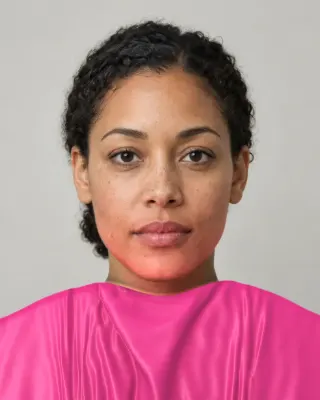
This is the mix-up we most want to clear up, since people with reddened skin often get told they’re cool and sold the wrong foundation. The difference is in where the color sits and whether it stays. The table under the figure is our rule of thumb:
| Cool undertone | Redness | |
|---|---|---|
| Where | Even, including neck and inner arm | Patches: cheeks, nose, chin |
| When | Stays through the day | Comes and goes with heat, exercise, wine |
| Next to pink cloth | Skin looks clear | Redness looks stronger |
| Next to green-based colors | Skin can look sallow | Redness often looks calmer |
Your body gives you a handy check. Xiao and colleagues measured skin at four sites and found redness highest on the forehead and lowest on the inner arm. So a forehead that looks pink proves little, and if your inner arm and neck are also pink in daylight, that means more. Blood color in skin isn’t a flaw, by the way. Stephen and colleagues found people adding it to face photos to make them look healthier.
Redness can have medical causes, and rosacea is a common one. The NHS describes it as redness across the nose, cheeks, forehead and chin that comes and goes, and notes it “may be harder to see on brown or black skin”. We can’t tell you anything about that from a color test. If it bothers you, a GP or dermatologist is the right person to ask. Do the undertone test on a calm day, and mostly look at your neck.
Cool undertones on deep skin
Most guides skip this, so let’s spend some time on it. Plenty of writing still assumes cool means pale. Dior’s own product copy describes its Cool family as “for light skin with cool undertones that rarely tans”, which describes a product range and also neatly shows the assumption. Deep skin can be every bit as cool as fair skin.
What changes is the sign. Clarins’ training manager says that with very deep skin “you may find it harder to see yellow or pink”, and that “a red, almost terracotta tone to the skin indicates a cool undertone.” So look for a red or rosewood quality in the brown, particularly where light catches the forehead and cheekbones, as opposed to the gold or honey you’d see on warm deep skin. In our figures, the gap between cool and warm at tone 8 is about half what it is at tone 6, and smaller again at tone 10. You won’t reliably see that on a phone screen. You’ll see it better next to fabric.
Nearly every test people quote for cool undertones falls over on deep skin, which is worth saying plainly:
- Blue veins: often not visible, and vein color comes from skin optics anyway.
- “Burns easily”: Skincare.com says cool skin tends to burn or freckle. That reflects low melanin far more than lean.
- White paper making skin look pink: hard to judge when the contrast with white is so large.
What does work is a same-strength pair in daylight. Try oxblood against winter burgundy, one warm and one cool, close in depth. If the burgundy makes your skin look clearer and more even while the oxblood makes it look flatter, that points to cool. The undertone test uses this pair among others.
What colors suit cool undertones?
Start from colors with blue in them, then adjust for depth and for how much contrast your coloring has. The Cool Summer palette is the softer option, and Cool Winter the stronger.
- Softer: rose, cornflower, cool teal, berry, soft sapphire.
- Stronger: true blue, fuchsia, clear emerald, cool ruby.
- On very deep skin: jewel tones and icy light colors both work, for different reasons. jewel rose and sapphire hold their own, and icy lavender stands well apart in lightness.
Clean white and true black tend to be friendly here, with navy and charcoal as softer stand-ins. Very orange and golden colors are the ones to test before buying, as they can leave cool skin looking sallow. Our cool palettes favor silver, platinum, white gold for metal, and if yellow gold is what you love, a paler or rose-toned gold is an easy middle ground.
Foundation labels for cool skin
Most brands use C, P or R for cool. M·A·C’s labels run the other way, as its own page spells out: warm (W) is “rosy” there, and cool (C) is “golden”. So someone with pink-leaning skin who walks in and asks for a C at M·A·C ends up in the golden shades, and looks yellow. Try the W side instead. Dior’s C and CR letters run the more common way, CR standing for Cool Rosy. Always check the key.
A cool shade should disappear on your neck as well as your cheek. If it matches your flushed cheek and sits pink on your neck, you’ve matched the redness, so go a step more neutral. The foundation shade finder gives a depth and undertone family. The lipstick shade finder covers the blue-reds, berries and plums that tend to suit this lean.
The light that fools cool skin
Warm bulbs get all the attention, but light can also push you the other way. Daylight runs from about 5000 K near the horizon to 6500 K on an overcast day, while a clear blue sky can reach 15000 K and above, and that’s what lights a shaded spot. In our simulation, with the same 30% of the cast left after white balance as our warm bulb figure, skylight moves neutral skin at tone 6 about as far as the distance between neutral and warm in our figures. Screens can do the same. So take your reading facing a window with indirect daylight, not in deep shade, and with your screen dimmed. See how to find your undertone for the rest of the method, and what undertone means if you’d like the background.
Related guides and tools
Sources
- How to find your skin tone and undertone
- What is my skin tone? The expert's guide
- Characterising the variations in ethnic skin colours: a new calibrated data base for human skin. Xiao K et al.
- Skin blood perfusion and oxygenation colour affect perceived human health. Stephen ID et al.
- Rosacea
- Why do veins appear blue? A new look at an old question. Kienle A et al.
- Human skin color
- Foundation shade finder
- Dior Forever foundation
- Color temperature

The Full Color Report: $19one time
You in your best and worst colors, about 40 colors with hex codes, makeup, hair and a capsule wardrobe plan.
See a sample reportCommon questions
- How do I know if I have cool undertones?
- Compare a cool and a warm color of equal strength under your chin in daylight. If your skin looks clearer and more even in the cool one, again and again, that points to cool. Check your neck too, since the face can show redness.
- Is pink skin always a cool undertone?
- No. Warm and neutral skin can both look pink when flushed, and fair skin shows blood color readily. Cool is an even lean that stays. Redness tends to sit in patches and come and go.
- Can dark skin have cool undertones?
- Yes. On deep skin, cool often shows as a red or rosewood quality in the brown instead of the pink it shows on fair skin. Veins and sun response don't help much here, so use same-strength color pairs in daylight.
- Are cool undertones rare?
- We didn't find a reliable figure, and we doubt one exists. Undertone has no standard cutoff, so any percentage depends on where someone drew the line between cool and neutral.
- Should cool undertones avoid gold jewelry?
- No need. Silver and platinum are the usual starting point, but taste and finish count for more than the rule. Rose gold or a paler gold is a good test if yellow gold looks brassy to you.
- What's the best lipstick for cool undertones?
- Blue-based reds, berries, plums and rosy pinks are the classic picks, with strength set by your depth. Bright orange-based reds are the ones to test first in person.

See which colors are yours.
See your colors on your own face, compare seasons side by side, and get your season, your undertone and a starter palette.