
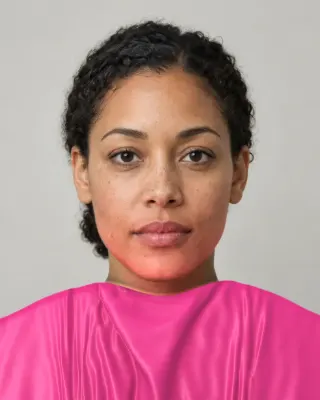
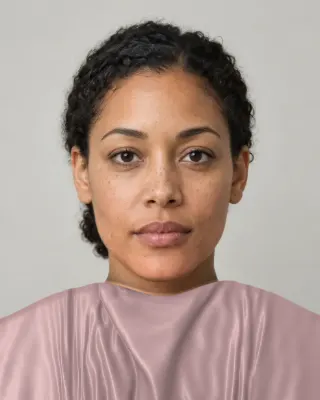
What this try-on does
This is a hair color changer that works on your own picture, live if you use the camera. You can use a photo instead, or watch it on one of our fictional example people. A multi-class selfie segmentation model from Google works out which pixels are hair, and we then shift only those pixels toward the color you tapped. Your hair’s highlights and the dark gaps between strands stay where they are, which is why it looks like hair and not a painted helmet.
You get ten fixed colors on the Hair tab, shown as dots with the name of the one you pick, and Fig. 1 below names them in the same order. From coolest to warmest they are silver, ash brown, black cherry, mushroom brown, espresso, ash blonde, chestnut, auburn, honey blonde, copper. The same stage has tabs for fabric, lips, clothes and metals, so you can see a new hair color next to a lip or a sweater. And there are three things it doesn’t do. It doesn’t filter those colors by your season, even when you arrive from a season page, where the address only loads that season. It has no brand catalog. On your own camera or photo, the try-on’s clip and which-is-better picture use these hair colors while you’re on this tab, and a screenshot works too.
How realistic is it?
Realistic enough to judge a color family against your skin, and not realistic enough to predict a salon result. It can look convincing near your natural depth and less so far from it, and the reason is a limit we built in on purpose. Dark hair holds very little light, so if you amplify that light too far, you stop seeing hair and start seeing camera noise. So the preview caps how far it can brighten at 3.6 times your hair’s average light, and how far it can darken at about a fifth of it.
Here’s what that means, worked through with the same arithmetic the preview runs.
Honey blonde
Ash blonde
Copper
Auburn
Chestnut
Mushroom brown
Ash brown
Espresso
Black cherry
Silver
Black
Dark brown
Medium brown
Dark blonde
Golden blonde
Read the top row. From black hair, every light chip stops at about the same depth. Honey blonde comes out as a dark warm brown, and silver comes out as a dark charcoal. From dark brown, honey reaches a warm light brown and still no blonde. Medium brown gets close to the chip itself. Going the other way is capped too: from golden blonde, espresso stops well short of the chip’s own darkness.
Will it work on dark hair?
Yes, and it’s most useful there for rich, deep colors. Auburn, chestnut and black cherry show up clearly on dark hair, since they’re near what the preview can reach. Pale chips won’t turn dark hair blonde or silver on screen. They’ll give you a warmer or greyer version of dark hair.
That limit happens to echo something real, though it isn’t a simulation of it. Josh Wood Colour says plainly that dye generally won’t make naturally black hair lighter, and lightening past a certain point means bleach. In fact, a real salon can take dark hair much further than our preview shows, with bleach and toner, at a real cost in time and hair health. So if you want to know how you’d look blonde and your hair is black, this tool won’t show it fairly. Use a photo of yourself with lighter hair if you have one, or ask a colorist to hold a swatch to your face. Hair color for brown skin goes through what lifting involves.
A few other cases to expect. Very short hair, tight curls and head coverings give the model less to work with, and it only colors what it marks as hair. The hair model runs a moment behind the face, and on smaller phones it waits until you ask for it. Grey or blond hair has more light to work with, so colors tend to land closer to the chip. If a preview looks wrong at the edges, try a plainer background or a photo with your hair clear of your shoulders.
Which color suits my skin tone?
That’s the “best hair color for me” question, and a preview answers it better than a chart, because you can see your own skin change. Two things are worth checking on each chip:
- Temperature against your skin. Brands agree on the broad rule. L’Oréal Paris says to pick a brown with the same undertone as your skin: ash and mushroom for cool, gold and red hints for warm, and nearly anything for neutral. Does your skin look clearer beside it, or more yellow, grey or flushed?
- Depth against your skin. Hair closer to your skin in lightness softens your face. Hair further away frames it. Neither is better, and our face contrast guide measures where you start.
Season systems offer a third lens. Here’s how the ten chips sit against our twelve palettes, measured by how close each chip comes to the nearest color on that season’s board. It’s a rough tool, since those boards were made for clothes. It does show one thing clearly.
The chips favor warm seasons. Deep Autumn has seven near its board and True Autumn has four, while Cool Winter has one and Cool Summer one. Soft Summer has four, with mushroom brown and ash brown among them. Of the ten, nine measure on the warm side of neutral, and only silver measures cool. Even ash brown reads slightly warm by our measure, though it’s the least warm of the browns. If you’re a cool season, start with ash brown, mushroom brown and silver, and read them as direction, since none of them is your exact shade. Our season guides cover the rest with level and tone advice: Soft Summer, True Summer and Soft Autumn. For specific colorings, see hair color for green eyes and hair color for olive skin.
If you don’t know your season yet, the season test takes it from your face. Some people call that a hair color analysis. Ours reads your hair as one input among several, so if you’ve dyed it, the reading follows the dye.
From a chip to salon words
Colorists think in two parts: a level for how light, and a tone for which direction. A dot on a screen doesn’t tell them either, so here is a rough translation of our ten. The level comes from matching each chip’s lightness to our screen approximation of the scale, and the tone word is our reading of its hue. Treat it as a way to start the conversation, since a professional chart will differ, and level numbers don’t quite mean the same across brands.
| Chip | About level | Tone to ask about |
|---|---|---|
| Honey blonde | 7 | Gold |
| Ash blonde | 7 | Beige or soft ash |
| Copper | 6 | Copper |
| Auburn | 4 | Red copper |
| Chestnut | 4 | Warm natural |
| Mushroom brown | 6 | Mushroom, or a soft ash |
| Ash brown | 5 | Ash |
| Espresso | 2 | Natural |
| Black cherry | 2 | Violet red |
| Silver | 8 | Silver, on hair lifted first |
How this differs from brand try-ons and AI hair apps
Search for a hair color changer and you’ll mostly find two kinds of tool. Brand try-ons show you that brand’s catalog, which is what you want if you’ve already chosen a box or a salon line, and they’ll offer far more shades than our ten. AI image apps generate a new picture of you, which can happily show black hair turned platinum, because nothing ties the result to what your hair is doing. Ours sits apart from both. It works on your own pixels, in real time, with a small fixed set, and it stops where the light in your hair runs out. That makes it weaker for dreaming and more useful for one question: does this direction suit my skin? If you want to see a big change, by all means try the others too, and treat what they show as an illustration.
What a preview can’t tell you
Real color depends on what’s already in your hair. Hair’s color comes from two melanins, eumelanin for darkness and pheomelanin for orange and red, and lifting exposes the warm pigment underneath. Wella frames every color as a starting point plus a chosen shade, with hair history and underlying pigment both part of that starting point. Our preview knows your hair’s average color and nothing about its history. So it can’t show:
- What previous dye, henna or box color will do to the result.
- How your hair takes color at the roots against the ends, or how porous it is.
- What brass looks like after six weeks of washing.
- What it’ll cost in time, upkeep and hair condition.
What to show your colorist
A screenshot works well if you bring it with a little more information:
- The direction you liked, in words: warmer or cooler, deeper or lighter, soft or vivid.
- Your natural level and history, including anything from the last few years. Colorists work on a scale of levels from black to very light blonde, so ask where you are.
- The chips you rejected. “I looked washed out with ash, and copper felt too loud” is very useful to someone choosing a tone.
- A real photo of the shade you want, because our chips are approximations and names don’t match across brands.
If you’re dyeing at home, read the kit. The NHS advises testing a dye on a strand at least 48 hours before use, and it notes that many permanent dyes contain PPD, a known cause of allergic reactions. The Full Color Report shows 3 hair colors on you, along with your full palette, for when you want more than a direction.